
Crypto miners are tearing off the “Bitcoin” label. At the end of 2025, Bitfarms announced it would gradually shut down its crypto mining business from 2026 and pivot to AI, with plans to rename itself Keel Infrastructure. Its CEO was even more blunt: “We are no longer a Bitcoin company.” In February 2026, Bitdeer went further, selling off all of its Bitcoin reserves.
The mining giants that once vowed to defend the “decentralization faith” with computing power have suddenly rushed, without looking back, into the arms of AI.
Faith Crumbles When Costs Hit $50,000
Bitcoin mining no longer makes money. Revenue has been cut back: after Bitcoin’s fourth halving in 2024, block rewards were slashed from 6.25 coins to 3.125. Costs, meanwhile, have surged. As of March 2026, mining one Bitcoin cost roughly $80,000 to $90,000.
The collapse in margins is even more stark. Core Scientific’s self-mining gross margin plunged from 23% in 2024 to 5% in 2025. Even Bitdeer’s gross margin in the fourth quarter of 2025 was down to just 4.7%.
A business that once threw off easy money is now barely covering its electricity bills.
But for the same companies, the numbers in AI look like they come from another world.
Core Scientific’s AI hosting gross margin climbed to 46% in Q4 2025.
IREN’s AI cloud services business is still small by revenue, but its hardware margin reached 97%, almost equivalent to selling electricity to AI customers.
For the same 1 megawatt of power, AIDC hosting delivers a 36% gross margin, while Bitcoin mining generates just 12%. If a customer is willing to pay a higher premium for your power and computing power, then stubbornly sticking with mining becomes, in the eyes of capital, an unforgivable act of charity.
Tech Giants’ Anxiety Becomes a Lifeline for Mining Farms
But if AI is such an attractive prize, why don’t the tech giants build their own server rooms? Why hire these “crypto mining barons” to reinvent themselves?
Because in the digital world, computing chips can be bought with money, but “time” and “power” cannot.
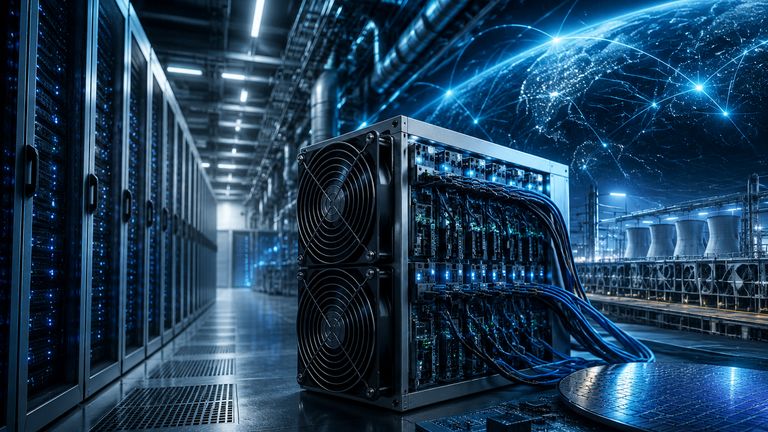
The U.S. grid today cannot handle AI’s enormous appetite, and building a new hyperscale data center takes at least three years. Miners, by contrast, already have step-down transformers, immersion cooling systems, and low-cost power purchase agreements signed years ago with local governments.
Converting an old mining farm into an AI facility can be done in as little as six months.
Core Scientific is the clearest example. Not long after emerging from bankruptcy restructuring, it used its mining farm assets to secure a 12-year contract with CoreWeave, converting an 800-megawatt mining farm into an AI data center.
By July 2025, CoreWeave simply proposed acquiring all of Core Scientific in a $9 billion all-stock deal, effectively saying: “I don’t just want to rent your site. I want to buy you outright.”
But in October, Core Scientific rejected the offer.
The market widely believed the offer was too low, especially because it was entirely stock-based and offered no floor-price protection.
The power assets held by miners are the real weapon. They are valuable enough that even AI companies want to swallow them whole. But miners are not fools. Why would they so easily hand over their own livelihood? For now, keeping the assets in hand while partnering with tech giants, and turning mining farms into AI computing power infrastructure, is the path that maximizes returns for miners.
IREN, the mining company founded by former investment bankers Daniel Roberts and Will Roberts, was named a “preferred partner” by NVIDIA in August 2025 and gained privileged direct access to GPU supply. In November of the same year, it signed a five-year, $9.7 billion agreement with Microsoft to provide 200 megawatts of IT load for AI computing power capacity.
Its share price rose more than 300% over the full year in 2025.
The industry understands that the surge is inseparable from its AI pivot.
As of March 2026, the total value of AI computing power contracts signed by listed mining companies had exceeded $65 billion.
At a staggering pace, they are becoming the super landlords of the AI era.
But that raises an uncomfortable question: what happens to Bitcoin? If everyone runs off to do AI, who will mine Bitcoin?
And what should people holding Bitcoin do?
Computing Power Has Not Betrayed Bitcoin. It Has Simply Matured
With more than $65 billion in computing power contracts shifting to AI, will Bitcoin’s “Great Wall of hashrate” collapse? The answer is no.
Unexpectedly, on March 21, 2026, Bitcoin mining difficulty automatically fell 7.76%, the second-largest drop since the start of 2026.
The network did not collapse. Instead, it smoothly filtered out unprofitable computing power that had fled, giving the miners who stayed some breathing room.
But this is exactly the sore point for the pure-mining camp. Mining companies are holding low-cost power agreements signed in earlier years, yet one after another they are turning themselves into landlords for tech giants.
Companies that insist on a pure mining path are deeply unhappy. They see this as a betrayal of the decentralization faith. They built their own mining farms and refused to pivot to AI, only to find that capital is abandoning Bitcoin.
But viewed outside the crypto world’s fixation, this is precisely a perfect asset repricing.
Miners are escaping the curse of violent boom-and-bust swings in Bitcoin prices and replacing it with stable AI rent for the next decade. AI giants are securing the scarcest physical space and cheap power. The Bitcoin network, meanwhile, gets a chance to reshuffle and leave behind the true believers.
Bitfarms’ new name, “Keel,” is a precise metaphor: the company has stripped away the “Bit” and kept the keel of power and infrastructure.
So how much is “faith” worth? Fidelity’s January 2026 report offered a number: for mainstream 20-25 joule equipment, hashprice would need to rise 40% to 60% for mining returns to catch up with AI hosting.
In other words, the premium for holding on to the faith is a 40% to 60% profit gap. There will certainly be people willing to pay that price, but the capital markets clearly are not among them.
In this great migration of computing power, no one has betrayed anyone. Once the romantic narrative of decentralization completed its historical work of awakening the market, the old faith did not die. It simply took on a harder business model, becoming the foundation for the next technological revolution.
Comments
00No comments yet. Be the first to weigh in.