
A sweeping blackout in Seattle and the awkward reality of Microsoft’s GPU clusters having no power to draw exposed a critical weakness in America’s AI industry: an electricity crisis.
When a single large-model training run by OpenAI consumes as much electricity as 1 million U.S. households use in a year, and data center-heavy Texas sees annual outage time exceed 1,600 minutes, a battle for power around computing power is already intensifying between tech giants and energy companies.
On Dec. 9, Google Cloud and NextEra announced a 15GW energy-computing power partnership, echoing a broader shift as 18GW of power in the U.S. crypto mining sector is repurposed. Together, the moves signal a formal reshaping of the energy strategy landscape for the AI era.
Dual Pressures Drive an Industry Shift
The U.S. power grid is facing an unprecedented double shock:
On one side, the “pulse-like flood” of electricity demand triggered by AI large-model training is overwhelming an aging grid with only a 20% reserve margin. In 2024, average outage duration per person in the U.S. surged 80% year on year to 662.6 minutes.
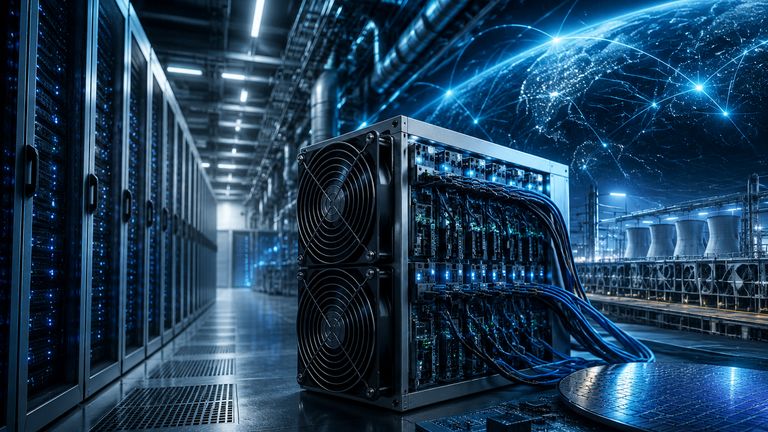
On the other, with a Bitcoin bear market approaching, 18GW of idle power in the crypto mining sector has become a scarce resource. Data show that nearly half of U.S. mining companies have begun transforming their high-density hosting facilities into AI computing power services, creating a precise match between a “computing power shortage” and “surplus power.”
“This is not a simple business pivot, but a revaluation of infrastructure,” an industry analyst said. Mining companies already have core advantages needed by AI data centers: low-cost power locations near generation plants, mature large-scale cooling systems such as immersion cooling, experience operating tens of millions of devices, and approved qualifications for power capacity expansion.
Cipher Mining’s 10-year HPC hosting agreement with Fluidstack is a typical example. Google provided a $333 million financial guarantee for the project, helping expand its Texas data center to 300MW. Total revenue over the full contract cycle is expected to reach $9 billion.
Dual-Track Deployment: Tech Giants’ Energy Strategy Breakthrough
The partnership between Google and NextEra is a benchmark case.
Building on an existing 3.5GW partnership, the two companies plan to add 15GW of generation capacity by 2035 and achieve “power self-sufficiency” through three data center campuses now under construction.
Google will embed its AI weather modeling and grid dispatch technologies into NextEra’s operating systems, improving outage prediction accuracy by 40%. It also plans to launch an AI-driven grid operations product by mid-2026, creating a closed loop between energy and computing power.
NextEra chief John Ketchum stressed: “The ability to generate power independently has become a core bargaining chip in the AI era.”
The crypto mining sector’s 18GW of power has become a key supplement.
Mining companies such as Cango have converted a 50MW site in Georgia, gaining AI infrastructure capable of directly taking on 20MW of hosting for less than $20 million. Its water-cooling technology, 90%-plus equipment uptime and other operational capabilities are better suited to GPU cluster needs than traditional IDCs.
OpenAI, Google and other giants have signed long-term agreements one after another. OpenAI alone has locked in more than a trillion-level computing power resources through multiple partnerships, including computing power clusters transformed from mining companies.
Technological change is rewriting the industry’s rules: from “IDC upgrades” to “energy heavy industry,” AI computing power demand is fundamentally overturning the logic of the data center industry. Traditional IDCs are classified as IT services, while AI data centers, with their extreme power density and cooling requirements, have been upgraded into “computing power heavy industry.”
In this transition, the technical advantages of mining companies and energy companies stand out: miners’ immersion cooling and dynamic power-load management technologies address the stability challenges of running GPU clusters at high concurrency.
Google and NextEra’s AI grid optimization technology has raised renewable-energy absorption rates by 25% and cut outage response times to the minute level. Adaptation work such as pluggable server boards allows mining farms to switch to AI computing power services without rebuilding, reducing transition costs by 60%.
Capital Markets Watch Coolly and Play the Long Game
Despite the pace of industry change, capital markets remain cautious. Shares of Google parent Alphabet were little changed on the day the 15GW partnership was announced, while NextEra’s stock slipped 1%, reflecting investor concerns over returns on long-term investment.
Analysts said grid-connection risk, uncertainty over technology iteration, and the payback period for infrastructure investment at the 100-billion-yuan scale are all questions hanging over the partnership.
But long-term value is gradually emerging: Cipher Mining’s shares jumped 12% in a single day after its shift into AI computing power, while Amazon’s stock rose 4% after a $38 billion OpenAI computing power agreement.
More importantly, electricity has replaced chips as the “base code” of AI competition: whoever controls stable and efficient energy supply earns the ticket into the computing power era.
Google and NextEra’s 15GW plan, combined with the transformation of 18GW of crypto mining power, is reshaping the global computing power map.
The future question is the next energy-tech pairing. As electricity becomes the hard currency of the AI era, the industry structure is being redefined.
On one side, Google, OpenAI and other giants are securing computing power supply through a dual-track model of self-built capacity plus hosted capacity.
On the other, mining companies are accelerating their transition through asset-light retrofits, such as Cango’s mining rig depreciation strategy, while energy companies are using AI technology to optimize grid efficiency.
This two-way convergence of computing power and energy is not only rewriting the rules for the tech and crypto mining industries. It also leaves one central question: when will the next game-changing energy-tech giant combination emerge?
Comments
00No comments yet. Be the first to weigh in.