
A quick note upfront:
This piece is not an easy read, and may even feel a bit brain-burning. But keep going and you will see that I am talking about the capital, psychology and cycles behind AI.
Just after China’s National Day holiday, global capital markets produced another new signal.
This time it came at a bigger layer of capital. On October 15, a $40 billion acquisition was finalized: several top U.S. investment institutions jointly bought one of the world’s largest data centers.
The day before, Google also announced in India that it would spend $15 billion to build a new AI hub.
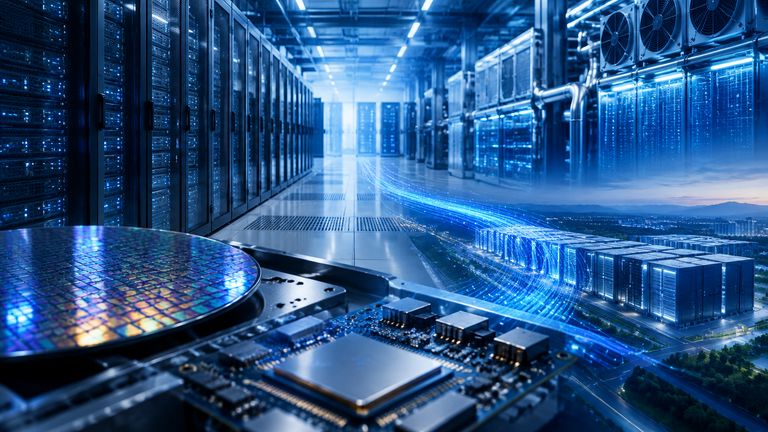
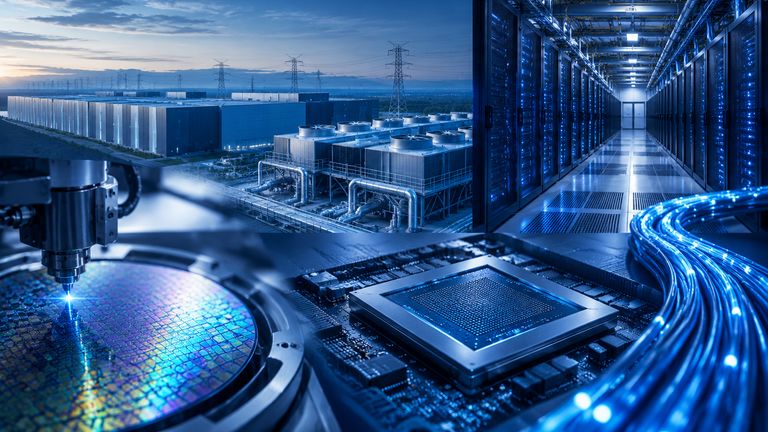
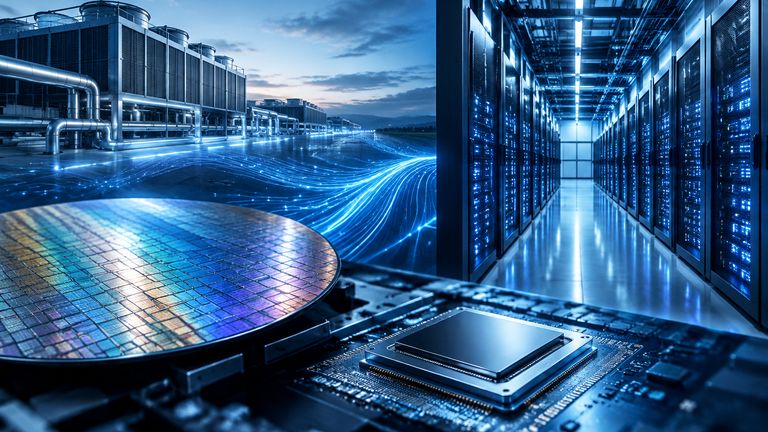
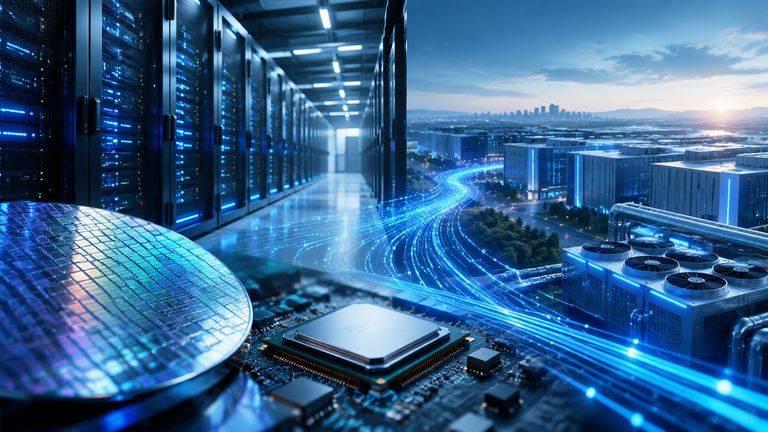
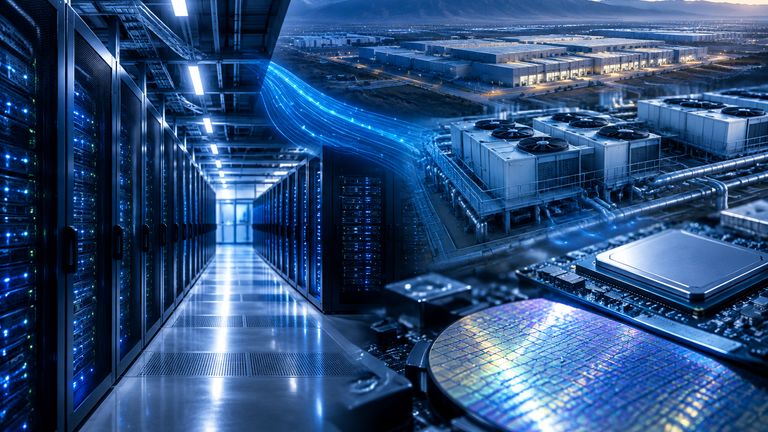
These may sound distant from us, but the two moves are telling: while everyone is still talking about models and agents, overseas capital has quietly started laying bricks. They are no longer speculating on algorithms, and seem less concerned with the application layer. Instead, they are all rushing toward one thing: the foundation.
So I have been thinking over the past few days: why, when everyone is looking up at the sky, have these companies started investing underground?
##
To understand this AI boom, we first need to look at where the money has gone.
I went through a batch of data, and the numbers are striking.
As of June 2025, annualized U.S. data center construction spending had climbed to $40 billion, about 30% higher than a year earlier. That is based on Bank of America Institute’s analysis of Commerce Department data, and Reuters has reported the same measure.
The global picture is even more extreme.
McKinsey estimates that by 2030, the world will need to invest nearly $6.7 trillion in data centers to meet computing power demand, with more than $5 trillion of that tied to AI workloads.
Even the IMF singled this out in a report, saying the AI investment boom is one reason the U.S. economy has been able to withstand downward pressure this year.
What does that mean?
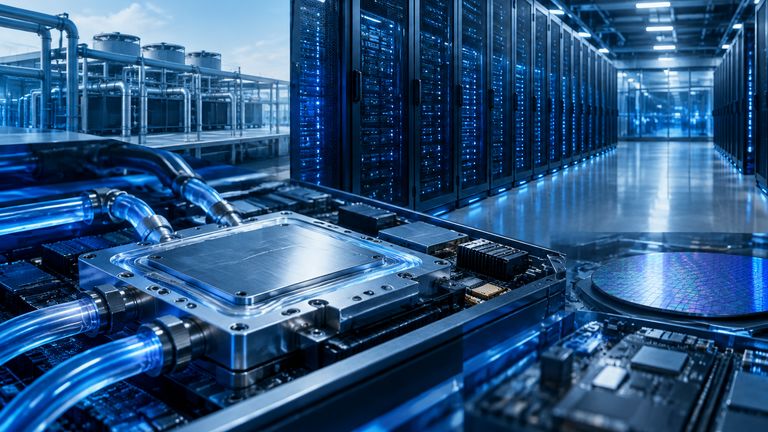
Everyone talks about “models,” but the money is all pouring into the physical foundation: electricity, land and cooling systems.
I see this as a “return of gravity.” Over the past decade, the internet trained capital to favor asset-light logic: fast replication, low costs and high marginal returns. But in the AI era, that logic has been completely reversed.
The smarter AI gets, the heavier the computing power behind it becomes. The larger the model, the higher the energy consumption. So the people who used to play with algorithms are now buying power plants, building server rooms and negotiating land leases.
This is the most overlooked turning point in the AI industry. At its core, AI is shifting from an “intellectual game” into a “physical war.”
To run a 10 trillion-parameter large model, GPUs alone are not enough. It also requires electricity, cooling systems and stable networks. Just as humanity once entered the age of electricity and aviation, AI has formally entered its own “heavy industrial era.”
So AI is a business that needs steel, land, water and electricity.
Almost all of the world’s most profitable companies have become computing power suppliers. NVIDIA is making extraordinary profits from chips, while Microsoft is racing to expand its data centers. What is this? A new round of the “digital gold rush.” Only this time, the real miner is capital.
I think there is a deeper logic behind this trend: AI is being recentralized.
In the future, every data center will be a new “urban node,” and every infrastructure investment will be a new form of “energy dispatch.” When data, computing power, electricity and land are bound together, the global resource chessboard is rearranged.
This is the so-called “physicalization inflection point” of AI: over the past two years, AI told its story through language models. Over the next few years, it will have to deliver on that future through power grids and land.
But once everything starts landing in the real world, new problems follow. For example: heavier capital means longer funding cycles. The more that is invested, the slower the payback. So how long will it take to recover this money?
##
AI infrastructure investment has long cycles, heavy depreciation and high costs. What it fears most is slow monetization. And this sector, as it happens, is slow.
Over the past two years, investor sentiment has been like a roller coaster.
In 2023, there was excitement. ChatGPT triggered a surge of belief, and everyone rushed in. In 2024, there was expectation, as everyone waited to see when AI would turn into profit. By 2025, investors had begun to feel anxious, because the math no longer added up clearly.
I asked an agent to run through several reports. The numbers were hard to ignore:
The price-to-earnings ratio of the U.S. AI sector has fallen from 58 times in 2023 to around 35 times this year. Almost all large-model companies are losing money, while the cost of AI cloud services is still rising.
This is the signal that the market has formally entered the “financial statement cycle.” Capital used to feed on stories. Now it wants spreadsheets: revenue curves, cash flow and payback periods. Patience has become a luxury.
I have several friends in investment research who were full of confidence at the start of the year. Now they are doing the math. They say AI’s “monetization logic” is too vague:
Technology is improving, but productivity has not risen meaningfully. The larger the model, the more expensive the computing power. Companies buy AI services, yet still do not really know what they are buying. The result is that capital has fallen into a delicate state: it cannot pull out, and it does not dare to add more.
I think this is a form of “cognitive fatigue.” AI has moved too fast in narrative and too slowly in delivery. In 2023, it was a narrative bubble. By 2025, it had become a cash-flow dilemma.
The market is also gradually realizing that this revolution is neither that fast nor that cheap.
Psychologically, this is a question of the “price of patience.” Interest rates have not yet fallen, inflation remains high, and waiting itself has a cost. Every quarter becomes a period of torment for investors, because capital’s time also accrues interest.
The real contradiction in AI is tempo. Technology advances exponentially, while commercial delivery is linear. Put those two lines together, and the gap keeps widening. Market sentiment naturally begins to swing. That is why investors are now most worried that “the future is too slow.”
This is also why many recent AI investment reports keep using the word “divergence.”
Large-model companies are still burning cash, while small-model companies are doing quite well. Hardware vendors are seeing profits surge, while software growth is slowing. AI’s wealth effect is starting to reverse.
At this pace, investor patience is like a rubber band being stretched tighter and tighter. Sooner or later, it will snap. And when capital becomes impatient, the real world’s response also begins to warp.
Masayoshi Son has also made his move this year.
In March 2025, SoftBank bought Sharp’s former LCD factory in Osaka, Japan, with plans to convert it into an AI data center. Three months later, Son unveiled an even bigger plan in Arizona: a $1 trillion “AI infrastructure park.”
It was one of his few public statements on the subject. The old gambler who once bet correctly on Alibaba and Arm has begun a new all-in push.
I think this unusual courage is a kind of “countercyclical patience.” When others hesitate, he adds more. When others worry about payback, he bets on the long term. This is the clearest footnote to the wave: technology is rising, and capital is diving deeper.
##
The biggest problem for AI today is not algorithms. It is energy.
I looked at one set of data, and it was alarming.
A hyperscale data center in the United States can consume as much electricity in a year as a city of 100,000 people. Another report said that one cloud computing giant uses more than 1 billion liters of water a year just to cool its servers.
What does that mean? In an arid region, it is almost like draining a small river.
AI’s appetite is being amplified worldwide. Every small advance in algorithms requires another rise in energy consumption behind the scenes. From electricity to cooling systems to land supply, it has become a real-world “big appetite revolution.”
This is another side of the AI boom that is easily overlooked. What it consumes is not just computing power resources, but public resources in society.
I looked into this. In Arizona, local residents have protested, saying data centers are “drinking the city’s water dry.” In Mexico, people have held signs in opposition because server rooms caused power outages.
In India, as soon as Google’s new base was approved, local media began asking: Is there enough electricity? Where will the water come from?
These stories may look like scattered details, but they point to one thing: technology is running up against the limits of land. I think this is what “AI landing” really looks like. It has crashed into reality.
From a geopolitical perspective, this “energy war” has already begun to spill over. The United States is competing for power. Middle Eastern countries are building “data deserts.” India, Indonesia and Vietnam are competing for the “right to host computing power.” Over the past decade, countries fought over “data sovereignty.” Now they are fighting over “computing power sovereignty.”
Whoever controls energy can feed the algorithms. Technology wants speed, society wants order, and energy sits right between the two.
I believe this infrastructure revolution is, in the end, a contest between capital and nature. From coal and oil to computing power and electricity, every technological revolution is essentially a redistribution of energy. This time, we have simply given it a new name: AI.
But revolutions never belong only to the winners. When energy tightens, communities push back and the environment is damaged, the glow of technology also casts a shadow.
So what I want to ask now is:
When resources are strained and environmental backlash grows, will humanity still keep betting on AI? I think it will. Because what we bet on has never been just technology. It is more like a cycle of “faith.”
##
The steam engine, electricity, the internet: each was once treated as a form of “salvation.” When humans are anxious, they always need something to believe in. It can be God, or it can be code.
AI is the latest form of that belief.
It makes us feel that a complex world can finally be computed, chaotic emotions can finally be understood, and even life choices can be “handed over to algorithms.” The stronger the technology becomes, the more people want to draw close to it. That force feels very much like certainty.
But the problem is this: no matter how perfect technology becomes, it cannot live our lives for us.
I have seen too many cycles like this.
When the boom arrives, people talk about the future. After the tide recedes, they talk about disillusionment. But as soon as the next wave of technology appears, everyone believes again: this time is different. So bubbles are neither right nor wrong. They simply cash in our desires ahead of time.
Look at it this way: the railway bubble left behind railways, the internet bubble left behind networks, and the AI bubble will also leave behind computing power, models, data and infrastructure.
This is human instinct: we use hope to push the world forward, and then use disillusionment to correct its direction. Faith is born from anxiety, bubbles come from faith, and value always appears after the bubble.
So when the bubble fades, will we remember why we believed in the first place?
AI has brought efficiency, and it has also brought illusion. It has forced humanity to face, for the first time, an existence that is more “intelligent.” But intelligence is not the same as understanding. When machines begin answering everything, we may find it easier to forget to ask “why.”
I think we are now in a delicate stage: the stronger AI becomes, the weaker people become, because we have started outsourcing choices, hosting our thinking elsewhere and transferring trust.
But think about it carefully. AI’s capabilities actually come from people. It is people who train it, and people who teach it to think. AI is only a mirror. It reflects our imagination of the future, and also our fear.
So the core of this boom is “what people still believe in.”
Many people believe in technology, and they also believe in cycles. But whenever a new boom arrives, I care more about who can remain. Because in the end, the future will not be delivered by models or algorithms, but by people.
Perhaps, looking back ten years from now:
New urban nodes, energy networks and algorithmic languages will all be traces of civilization moving forward. But the narrative around AI infrastructure has not yet swept into China in this new round.
Overseas investors, meanwhile, have already begun to fall into another cycle: from expectation, to anxiety, to doubt. In the end, is this not just another form of FOMO?
Comments
00No comments yet. Be the first to weigh in.