
On November 13, robot application service platform Qingtianzu announced the closing of a strategic funding round worth hundreds of millions of yuan. Investors included Heda Investment, Mango's industry investment partner Houwei Capital, and Zhonglian Jisong. The company disclosed no figure beyond "hundreds of millions of yuan."
Funding announcements usually move on at this point to explain how the money will be spent, and this one did: developing application services, implementing the Worken practical training system, building a full industry ecosystem, and upgrading the nationwide service delivery network. The first and fourth are standard fare. The second is not. By putting a "practical training system" on its investment list, a robotics service company is effectively acknowledging that the hardest part is not acquiring robots, but getting them to perform work that customers recognize as valid.
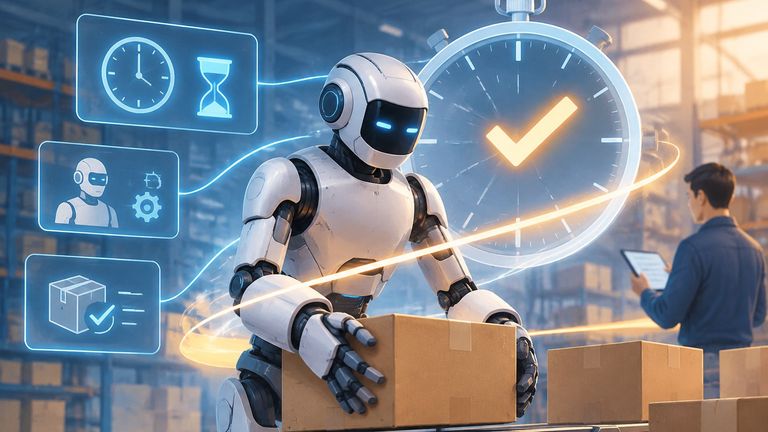
The original text offers just one explanation of Worken: work plus token, designed primarily to measure robots' effective intelligent working hours. That one sentence says more than the funding figure does.
Every Word in "Effective Intelligent Working Hours" Rules Something Out
Start with "working hours," the most basic layer. It shifts the basis of pricing from units of equipment to time. Charging for a robot by the day follows the logic of equipment leasing; charging for an hour of completed work follows the logic of a service business. The former sells availability. The latter sells output.
Adding "effective" introduces another layer by excluding mere powered-on time. A robot standing by and one working continuously for eight hours may experience similar equipment wear, but their output differs by an order of magnitude. If customers are billed for powered-on time, they will feel they are paying for idle equipment. If they are billed for effective time, the service provider must answer for why the robot was not working.
Adding "intelligent" creates a further distinction, excluding manual remote control and preprogrammed routines. A person operating a robot with a controller and a robot that perceives, decides, and acts autonomously create entirely different value for the customer and impose entirely different costs on the service provider. The former costs an operator's salary; the latter requires a model and an operations and maintenance team. If both are billed at the same rate, the provider delivering genuine autonomy is bound to lose money.
Taken together, the three terms draw a line around what counts: the machine must be working rather than standing by, acting on its own rather than being operated by a person, and measured by productive time rather than idle runtime. Only once customers accept that line can the service provider price its offering by output.
Work Plus Token: Finding a Billing Unit for Physical Labor
The source explains Worken as a combination of work and token. In language models, tokens are the smallest billing unit: the number of tokens consumed by a request determines the bill. Applying that logic to the physical world means answering the same question: what is the "unit" consumed when a robot performs a task?
Tokens are relatively easy to define for language models because text is naturally discrete: a passage is divided into countable chunks. Physical labor is not. Moving a box and inspecting a production line involve different sequences of actions, durations, and levels of environmental complexity. That is why Worken must be tied to "working hours." It begins with time as a universal measure, then uses "effective" and "intelligent" to exclude the parts that should not count.
This also explains why the source links Worken to a practical training system. Units of measurement are not simply defined; they must be calibrated. Determining how many units the same type of task is worth in different settings requires repeated benchmarking against real-world work. Completing a task in a training environment does not make it priceable. The unit becomes credible only after producing stable results on a customer's production line.
From Selling Robots to Selling Output, the Risk Shifts
Changing the basis of pricing also changes who bears the risk. When robots are leased by the unit, the service provider's risk is idle inventory. Once a machine has been rented, the provider still collects rent, and the customer bears the loss if it is underused. When pricing is based on output, the provider instead assumes the risk of falling short on delivery. If the robot is running but fails to do the job properly, the provider cannot collect payment for that order.
This is not a question of which model is fairer. The required capabilities are different. Leasing by the unit depends on asset turnover and distribution channels. Charging by output depends on task decomposition, exception handling, and on-site support. The former leans toward finance; the latter toward operations. They require two different teams.
Qingtianzu says it wants to build a service system spanning equipment resources, fleet scheduling, local deployment, and continuous operations. Those four stages map directly onto the output-based business model: securing the equipment, deploying multiple robots at the same site, implementing the system at the customer's location, and supporting it over the long term. If any link is missing, the promise of output cannot be fulfilled.
Three Investors, Three Scenarios, Three Pricing Challenges
The capital in this round is not all of the same kind. Heda Investment is contributing support for regional industrial expansion and the aggregation of technology, talent, and service resources. It will also help implement the Worken practical training system, putting both people and real-world settings behind the calibration process.
Mango's industry investment partner, Houwei Capital, aims to connect intellectual property content with embodied intelligence. Pricing in this field is almost the reverse of pricing in industrial settings: the value of performances and offline interactions lies not in the number of hours worked, but in their impact and ability to generate attention. Worken's "effective intelligent working hours" model is difficult to apply directly here.
Zhonglian Jisong is opening up real-world logistics settings such as last-mile delivery and industrial park services to refine fleet operation plans. Of the three investors, it is the closest fit for Worken: tasks are repetitive, countable, and comparable, making them well suited to calibrating the unit.
Putting the three scenarios side by side also exposes a problem: one measurement framework will struggle to serve three different businesses. Logistics requires countability, while performances are judged by their impact. "Effective" means fundamentally different things in the two settings. The source does not explain how Worken plans to address this difference, saying only that it will be incorporated into the practical training system.
Twenty Operations Centers, 54 Cities
The service delivery network currently comprises 20 operational centers across China, covering Beijing, Shanghai, Guangzhou, Shenzhen, and Hangzhou. In its first phase, the company plans to establish service nodes in 54 cities.
Going from 20 to 54 is nearly a threefold expansion. That pace would be unremarkable for a software business, but it is a hard constraint in robotics services. Robots can get stuck or fall over, and they need people to move them around. A remote reboot cannot fix a physical malfunction. The density of service nodes directly determines how quickly someone can reach the site when something goes wrong, which is the minimum requirement for fulfilling an output commitment.
The source compresses this point into a reference to "improving cross-regional robot deployment and service responsiveness," without elaborating. But in a business that charges by output, responsiveness is not merely a measure of service quality. It is a cost item. Arriving within two hours of a failure carries a different financial penalty than arriving two days later.
The Business Works Only Once the Unit of Measurement Is Defined
Deng Feng argues that AI should not remain confined to screens and chat boxes. It should enter the physical world through robots and other forms of embodied intelligence to solve real problems in production and services. He says robots will create value not only through individual machines, but increasingly through fleet deployment and coordinated operations. Measuring their productivity and commercial value will therefore require a combination of robot numbers, continuous operating time, and actual work efficiency.
That argument is worth unpacking because the three dimensions form a multiplication: the number of robots, their continuous operating time, and their actual work efficiency combine to determine total output. Worken is essentially an attempt to give that product a unit. Without one, it remains an internal metric. With one, it can enter contracts, invoices, and financial statements.
This is also the most easily overlooked aspect of the funding round. Hundreds of millions of yuan cannot buy an industry standard, but they can buy the time and real-world settings needed to calibrate one. Turning Worken into a practical training system requires a foundation of real-world operations, and the 20 operations centers and planned presence in 54 cities provide the places to build that foundation. Whether customers and the broader market will ultimately accept the unit remains unanswered. For now, Worken has advanced only as far as the implementation of its practical training system.






Comments
00No comments yet. Be the first to weigh in.