
AI can write code and make pictures, but here's one you may not have seen coming: AI is about to run bitcoin mining farms directly.
On October 24, stablecoin giant Tether announced something big.
Fifteen of the world's top bitcoin mining companies pledged to join MDK (Mining Development Kit), an open-source framework launched by Tether, to build a single unified interface for mining hardware worldwide.
Rig makers, mining pools and mining farm operators, who normally go their own way, sat down at the same table for the first time.
The goal is not only to clean up more than a decade of mess in which mining machines could not be managed under one system, but to pave the way for AI to take over bitcoin mining farms outright.
Thousands of Rigs, None Speaking the Same Language
To understand what Tether is doing, start with how painful mining farm operations are today.
Bitcoin mining stopped being a small-time business long ago.
Network hashrate hit an all-time high of roughly 1.16 ZH/s (about 1,157 EH/s) in October 2025 before falling back sharply, dropping to a low of 850 EH/s in February 2026, about 27% below the peak, but it has since climbed back above 1 ZH/s.
On October 22, actual hashrate returned to 1,000 EH/s, with the seven-day average holding above 1 ZH/s.
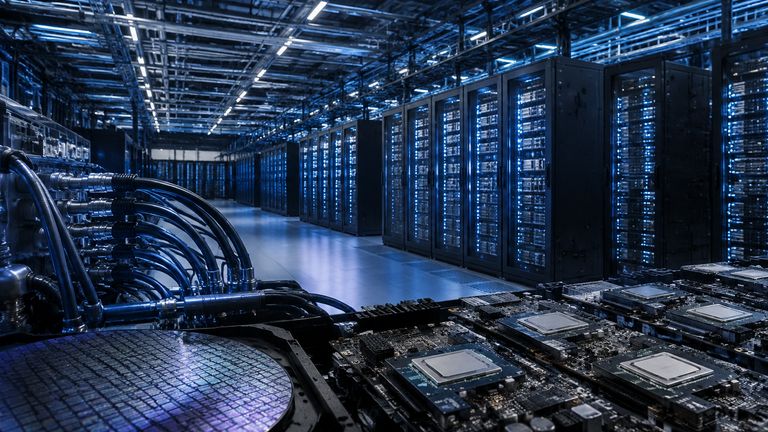
In practice that means today's mining farms are all large-scale industrial data centers.
For all that scale, the way they are managed remains remarkably primitive.
A large mining farm often runs thousands of machines, which may include Bitmain's Antminers, MicroBT's Whatsminers and Canaan's Avalon rigs all at once.
The problem is that every manufacturer has its own firmware, interfaces and back-end management system, and none of them talk to each other.
A mining farm operator who wants to monitor every machine on one screen has to hire programmers to write the integration code.
Switch mining pools midway and the code has to be rewritten. If a manufacturer pushes a system update, the software written earlier can break instantly, forcing the operator to start over.
Mining has been around for more than a decade and its chips have been pushed down to the nanometer scale, yet the management software is still stuck at the stage where nothing speaks a common language.
If your software can control vendor A's machines but not vendor B's, so-called intelligent management ends up being workers sitting in front of screens clicking buttons by hand.
That is why a single call from Tether on October 24 was enough to bring in Bitmain, Canaan and MicroBT, three bitter rivals in rig manufacturing, along with major pools F2Pool, SpiderPool and OCEAN, large mining farm operators Bitdeer and Foundry Digital, and the Proto and StratumV2 teams under Block.
The whole industry has had enough of this outdated way of working.
Build a Translator, Then Invite AI In
Since nobody speaks the same language, Tether's fix is simple: build a universal translator.
Tether open-sourced a mining operating system, MOS, in February this year, then launched the MDK development framework on top of it on April 27.
Written in JavaScript and React, the framework is free to use for everyone from home hobbyists to gigawatt-scale mining farms.
The mechanics are straightforward. Each of the 15 participating companies writes a small plug-in called an "MDKWorker" that translates data from its own machines and pools into a standard format.
A mining farm operator installs a single control console on top and can direct machines from every brand at once, with no more lock-in to a single vendor.
Tether handled one part of this particularly deftly.
It lets manufacturers decide which functions to expose, requires no replacement of existing equipment, and does not ask them to hand over low-level control of their systems.
That immediately eased the concerns of hardware heavyweights like Bitmain.
What the big manufacturers fear most is losing their technical moat once interfaces are standardized. With their core interests protected, they were willing to join.
Tether is also moving fast. MDK was upgraded to v0.11 during the Plan ₿ forum in Lugano, and the company plans to ship the first stable 1.0 release before the end of 2026.
But if you think Tether went to all this trouble just to save mining farms a few programmer salaries, you are missing the point. The real aim is to bring AI in.
QVAC, Tether's own mining AI agent, is already running on the MDK framework as its first showcase user.
Tether CEO Paolo Ardoino has been blunt about it: software will no longer just "watch machines run" but will "manage machines in place of people." If every machine speaks a different language, AI simply cannot operate at scale.
Once MDK links every machine into a single network, the person at the keyboard will no longer be an on-duty engineer but an AI algorithm.
How to adjust power draw when electricity prices swing, which machine is overheating and needs to be throttled, which batch of hashrate should switch to a more profitable pool: all of it used to require humans watching screens and doing the math. In future, AI will issue those instructions automatically within a second.
A Grand Vision With Plenty of Risk
Tether has painted an appealing picture, but three problems stand in the way of making it work.
First, what the 15 majors signed is only a pledge.
In the October 24 announcement, Tether said the 15 companies had "committed" to joining, without disclosing how many machines have actually installed the system, what share of network hashrate that represents, or how much money it has saved mining farms.
Between a verbal yes and code running on tens of thousands of rigs lie countless rounds of technical debugging and negotiation over commercial interests.
Second, industry standards have never been settled by a press release.
Mining has seen plenty of previous attempts to unify standards, and most of them fizzled out.
The StratumV2 team on this list, for instance, has been working on standardizing mining pool protocols in its own right.
With two standard-setting teams now under one roof, whether this becomes a genuine alliance or a quiet contest of agendas is anyone's guess.
Third, and most worrying, is the security risk of letting AI run mining farms.
Industry outlet CryptoSlate published a pointed question: if the CEO wants AI to operate mining farms directly, who decides where the AI's authority ends?
Keep in mind that mining farms run real industrial machinery and burn real money in electricity.
If an AI capable of commanding hashrate across every brand has a software bug or gets breached by hackers, machines in the physical world have no undo button. Burned-out equipment, or even grid instability, is a cost nobody can absorb.
Some industry figures have also pushed back, arguing that Tether's move is far too centralized for the bitcoin world and that these majors will never truly cooperate. If the company genuinely wants to contribute to the industry, they say, it should put forward an open-source, decentralized approach.
Tether's calculation here is fairly plain.
It is sitting on enormous interest income from issuing the USDT stablecoin, and it is now pouring that money into bitcoin's underlying software.
It does not build rigs and it does not build mining farms, but it wants to become the indispensable manager that every mining farm has to go through.
History shows that whoever sets the standard does not always win in the end, but any industry that wants AI automation at scale needs a common standard first.
Bitcoin mining is, by nature, an industry of machines consuming electricity and dealing purely in numbers, which makes it a natural fit for AI management.
The question mining farm operators should be asking, as Tether smooths the road and puts AI in the driver's seat, is whether they still have their hands on the wheel.

Comments
00No comments yet. Be the first to weigh in.