
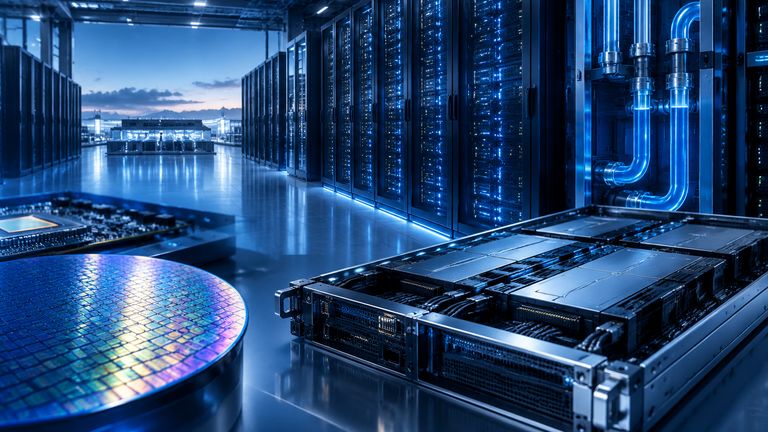
China Mobile's Beijing branch and China Mobile Cloud announced on September 29 that Huawei's Ascend 950DT 1,000-card SuperPod has gone live at the Mobile Cloud Beijing node inside the Information Harbor data center in Changping district. According to the website of the Changping District People's Government, the deployment is "not an ordinary resource rollout, but a national demonstration project."
The SuperPod packs 1,024 cards into a single node, delivering 1 EFLOPS of computing power (FP8), with support for 256TB of unified memory and microsecond-level latency. Its larger significance lies not in single-node performance but in the compatibility layer underneath it: Mobile Cloud has completed support for nine domestic AI chips, including Ascend, T-Head, Kunlunxin, Moore Threads, Enflame, Biren, Hygon, MetaX and Iluvatar CoreX.
From Computing Resources to a Computing Ecosystem
This is not a routine server procurement. As the Changping district government frames it, China Mobile is using the capital as a pivot point, building a fully domestic computing power ecosystem on the Information Harbor Mobile Cloud SuperPod, supporting the Beijing-Tianjin-Hebei hub of the national integrated computing power network and setting a "replicable, scalable model" for domestic AI computing nationwide.
Two Layers of Technical Integration Behind the 1,000-Card SuperPod
According to the China Association of Communication Enterprises, the Ascend 950DT chip and Mobile Cloud are tightly integrated at several levels: the chip carries high-bandwidth memory with 4TB/s of memory bandwidth and 2TB/s of per-card interconnect bandwidth, and supports a range of low-precision compute formats. The 1,000-card SuperPod deployed at the Beijing node is built on Huawei's SuperPod architecture, with a single node of 1,024 cards delivering 1 EFLOPS (FP8), 256TB of unified memory and microsecond-level latency.
Those two figures, 256TB of unified memory and microsecond-level latency, speak to the hardest part of large-model training and inference. The point of a SuperPod is not stacking a thousand cards together, but making them work as a single computer, pushing cross-card communication latency down toward in-rack levels.
A Compatibility Layer Sits Behind the Nine Chips
What matters about the "domestic chip" layer is not which chip was used, but that nine are supported at once.
Mobile Cloud has completed compatibility work for mainstream domestic AI chips including Ascend, T-Head, Kunlunxin, Moore Threads, Enflame, Biren, Hygon, MetaX and Iluvatar CoreX, and uses its in-house AI compute management platform to unify access to and management of this mix of silicon. The platform monitors and actively checks hundreds of metrics across compute, networking and storage to keep training and inference jobs running stably.
Worth clarifying: the nine chips make up the compatibility list for the Mobile Cloud platform as a whole, not nine chip types installed in this one Changping facility. The SuperPod deployed here runs on Ascend 950DT.
Supporting nine chips at once gives the carrier room to maneuver on chip supply, and it also carries a real engineering cost. The nine chips differ in instruction sets, software stacks and interconnect designs, and wiring them all into one management platform means working through operator adaptation, framework compatibility and stability testing for each. That work never makes the highlight reel in a press release, but it determines whether "domestic computing power" is usable or merely listable.
The "Domestic Model" Layer: 300 Models and a Path to Lower Costs
Progress on the model side is just as concrete. MoMA, China Mobile's one-stop large-model service platform, has assembled more than 300 mainstream models. With the 1,000-card SuperPod now live, MoMA will push those models through deep adaptation and tuning on Ascend 950DT, closing the loop from model aggregation to deployment on domestic computing power to performance optimization.
According to the China Association of Communication Enterprises, MoMA has already cut unit usage costs by roughly 30% and reduced resource consumption by more than 50% by running on domestic computing power with its in-house inference engine.
Those two numbers are central to reading the commercial case for domestic computing power. If a 30% cost reduction holds up at hyperscale, the competitive question shifts from whether domestic silicon can be used to how much it saves, and the latter is what actually decides whether customers migrate.


Comments
00No comments yet. Be the first to weigh in.