
China’s AI computing power has hit the accelerator and entered the 100,000-card era.
On July 10 in Zhengzhou, Sugon announced that its fully domestic AI supercluster, Sugon 8000 (Dengfeng), had been officially completed and, via the National Supercomputing Internet, connected simultaneously to the national integrated computing power network.
One hundred thousand domestic accelerator cards are now up and running.
This is not simply an oversized 10,000-card cluster. Moving from 10,000 cards to 100,000 is not a matter of adding a few zeros; it is an entirely different engineering problem.
How to keep the network from clogging, storage from collapsing, cooling from overheating, and scheduling from breaking down: every order-of-magnitude increase in scale multiplies system complexity exponentially.
More importantly, this cluster is not following the old path of simply stacking cards.
A Token Factory That Can Handle Two Kinds of Work
AI computing power centers today face a common awkward reality: many clusters built for large models cannot run scientific computing, while those built for scientific computing cannot train large models.
This structural mismatch, useful to neither side, leaves large amounts of computing power sitting idle in machine rooms.
Sugon 8000’s answer is “native supercomputing-AI integration”: one system that can handle FP64 double-precision scientific computing workloads while also fully supporting the training needs of trillion-parameter large models.
It covers the full precision range, from FP64 to INT8.
This is not supercomputing and AI data centers stitched together. It treats the two tasks as one from the architecture design stage.
Put another way: the old approach was to build one road for trucks and another for cars.
Now the goal is to build one road that can carry both trucks and cars. They may all look like roads, but the design logic is entirely different.
Although the idea of “supercomputing-AI integration” is not new, Sugon 8000 is, without question, a practical path for optimizing domestic computing power allocation as the industry’s first 100,000-card computing power cluster built on a native supercomputing-AI integration route and supporting full-precision computing.
By building a “supercomputing-AI integration” platform, it pools resources from dispersed supercomputing centers and AI data centers and enables unified scheduling across platforms and architectures. That has real leading significance for improving domestic computing power utilization and reducing the cost of redundant construction.
The Engineering Breakthrough Is in the Machine Room, Not on Paper
The industry understands the engineering difficulty of a 100,000-card cluster, yet Sugon has still set a historical record.
The system was developed in 2024, construction was completed in 2025, 30,000 cards went online for trial operation on February 3 this year, a 60,000-card AI4S cluster was put into service in April, and the 100,000-card deployment landed in July.
This striking engineering feat comes from Sugon’s more than 30 years of accumulated engineering capability.
According to Li Bin, senior vice president of Sugon, Sugon 8000 has full-chain, fully domestic self-developed capabilities across chips, computing, storage, networking, cooling, management, and services.
Among them, domestic chips from companies including Hygon provide the system’s underlying support;
a scaleFabric IB-like native RDMA high-speed network enables highly reliable connectivity for the 100,000-card cluster;
ParaStor distributed storage supports massive data reads and writes in large-model training and scientific computing, and ranked first on both the production full-node and 10-node performance lists in the 2026 Global IO500 ranking.
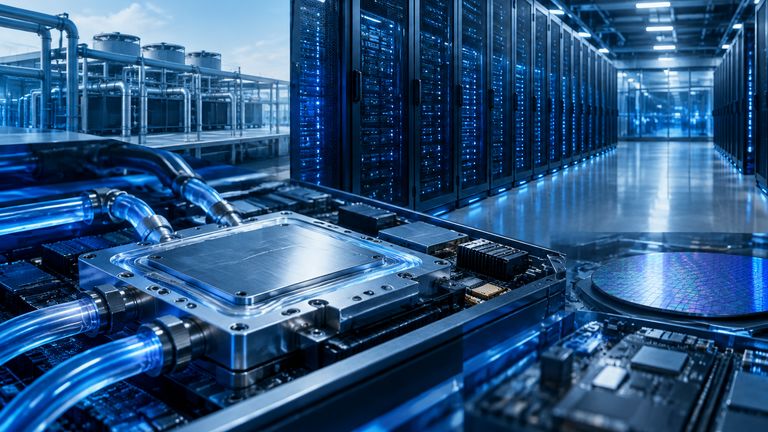
In addition, combined with Sugon DataEnergy’s core strengths in liquid cooling technology, the system can effectively support megawatt-class high-power-density deployment and sharply improve Sugon 8000’s energy efficiency through domestic refrigerants, year-round natural cooling, and other methods.
What is rare is that such powerful engineering capability is not being used for technical showmanship.
Sugon has also connected Sugon 8000 to the National Supercomputing Internet, opening it to research institutions and industry through computing power services.
It has already completed adaptation for more than 300 applications, covering more than 20 fields including materials, electromagnetics, quantum science, biomedicine, astronomy, and meteorology, and has completed more than 70 computing power tests at 10,000-card scale.
The Real Test of Computing Power Is Not Benchmarks, but Utilization
The AI industry has a repeatedly proven rule: the parameters shown at a launch event never outrun the test of real business conditions.
Sugon 8000 has already delivered results in real-world scenarios.
It used 80,000 cards to accelerate full-process protein-folding simulation, directly serving new drug development;
88,000 cards completed a 328-trillion-grid direct numerical simulation of turbulence, supporting high-end manufacturing such as aviation and shipbuilding;
90,000 cards worked together to complete high-precision DFT simulation of 3.16 trillion atoms.
These are not PowerPoint numbers. They are world-class results produced by research teams on domestic computing power.
More notably, Sugon 8000 uses an open AI computing architecture, supports multiple brands of AI accelerator cards, and is compatible with mainstream ecosystems.
That means frontline developers and researchers do not need to learn a closed toolchain from scratch, and existing models and applications can be migrated and brought online quickly.
Another benefit of openness is that it allows the entire industrial chain to participate, rather than merely watching one company perform alone.
During the conference, Sugon and the Beijing Academy of Artificial Intelligence for Science reached a strategic partnership and officially launched the development and construction of a second fully domestic 100,000-card supercomputing-AI integrated computing power system.
Sugon 8000 is moving from a demonstration project toward a replicable standard solution.
A Harder Road, a Bigger Game
East Data West Computing, the national integrated computing power network, and the National Supercomputing Internet all share the same top-level design goal: to make computing power flow like electricity.
Sugon 8000’s placement in Zhengzhou carries clear strategic significance.
Zhengzhou’s location, energy conditions, and status as a network node make it naturally suited to serve as a hub connecting computing power in eastern and western China.
With this move, a backbone node of the national computing power network now has 100,000-card-level carrying capacity.
As more 100,000-card-level nodes are rolled out nationwide, China will be the first to weave together the world’s largest computing power scheduling network.
That is the view truly worth watching after Dengfeng reaches the summit.

Comments
00No comments yet. Be the first to weigh in.