
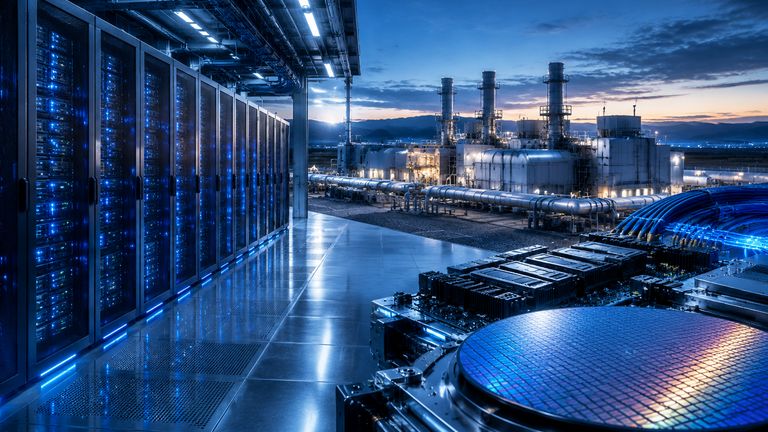
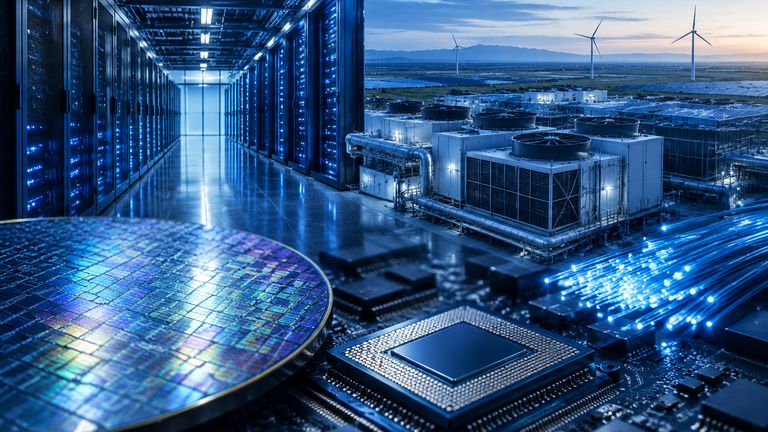
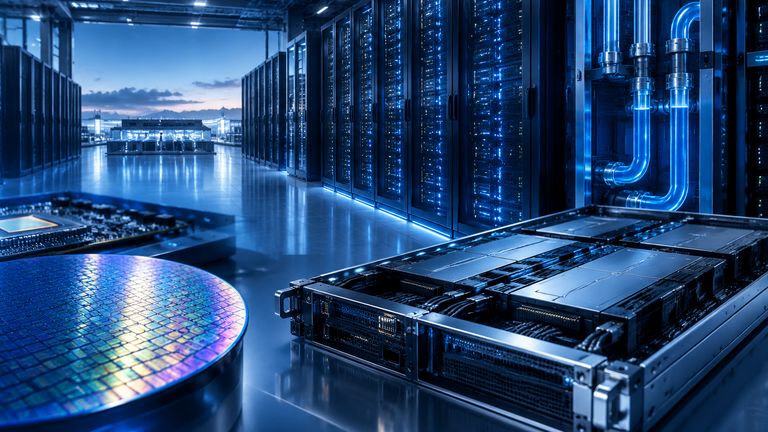
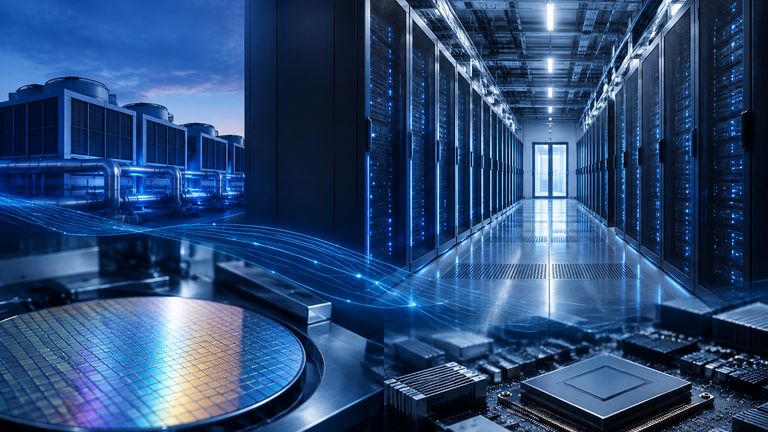
At GTC in Berlin on October 21, Jensen Huang unveiled a product called the DSX POD: an entire AI factory packed into a shipping container ahead of time, trucked to the site and ready to run the moment it's plugged in.
The tech world called the idea brilliant. Bitcoin miners just smiled: isn't that the container mining farm we've already worn out?
One Container, One Entire AI Factory
Start with the sheer specs of the box itself.
A single DSX POD is roughly the size of a standard shipping container, weighs about 28 tonnes, and can be hauled down a highway by an ordinary truck. Ian Buck, NVIDIA's vice president of hyperscale computing, says each box contains around 10 million components.
Inside: seven Vera Rubin NVL72 liquid-cooled racks, 504 of NVIDIA's latest Rubin GPUs, plus 252 Vera CPUs.
Take one rack on its own: 72 GPUs paired with 36 CPUs, linked by the new generation of NVLink into a single giant accelerator. Each rack delivers 3.6 exaflops of NVFP4 inference performance, five times the previous GB200 NVL72, which came in at roughly 720 petaflops.
Memory is the latest HBM4, 20.7TB per rack, with rack-level memory bandwidth approaching 1,600TB per second.
That means one box with seven racks tops 25 exaflops of inference performance. A fully loaded rack draws roughly 190 to 230 kilowatts, making the whole container a 1.3-megawatt-plus power draw.
Analyst estimates cited by CNBC put a single Vera Rubin rack at more than $7 million, which means the racks inside one container alone are worth close to $50 million.
Which explains how Huang framed the product: "An AI factory only creates value the moment it starts producing tokens, not the day the building is finished."
The first DSX POD units are slated to arrive at customer sites in early 2027.
Moving Six Months of Construction Into the Factory
Why go to the trouble of packing AI gear into a shipping container?
Because on-site assembly is simply too slow.
Building an AI data center the old way meant workers connecting network cables and plumbing water lines by hand once the equipment reached the site. The Spectrum-X network in a single base unit alone requires 17 kilometers of cabling, on top of roughly 20 kilometers of NVLink copper and 3,500 cables. All that work takes at least six months.
So NVIDIA built the DSX POD instead: an AI factory in a shipping container.
Seven Vera Rubin NVL72 liquid-cooled racks, 17 kilometers of network cable, 800V DC power distribution gear and the liquid cooling plumbing are all installed, connected and tested at a partner factory in advance. Then the whole box ships to the customer's site.
As long as the site's power and water are ready, a build that once took about six months can be done in as little as 14 days.
Speed aside, the box is also unusually frugal with water.
Cooling large machine halls used to mean building traditional evaporative cooling towers, the ones with the white plumes, which consume enormous volumes of water daily. The Vera Rubin racks here support 100% liquid cooling and can still carry heat away with inlet water as warm as 45°C. Paired with closed-loop dry coolers, air alone brings the hot water back down for reuse, largely eliminating the need for cooling towers.
By NVIDIA's math, at 2GW of power, the approach saves 54 million liters of water a day.
But this combination of factory pre-assembly and water-saving dry cooling is something Bitcoin miners have had down cold for years.
Miners Figured Out the Container More Than a Decade Ago
Years ago in Sichuan, Xinjiang and Inner Mongolia, miners were already running container mining farms.
The box was built in a factory with switchgear, air ducts and network cabling all integrated inside, then hauled out to some remote spot with power, plugged in and mining.
Bitcoin mining's requirement has always been blunt: wherever power is cheap and stable, computing power needs to get there fastest. A cohort of vendors built specifically for that, turning container prefabrication, megawatt-scale power distribution, high-density cooling and remote operations into standardized products.
The best known is mining rig giant Bitmain, which built the ANTSPACE line of containers for exactly this.
(Photo: Bitmain's ANTSPACE water-cooled mining containers, with power distribution, cooling and networking all factory-installed.)
The HK3 water-cooled container, for instance, fits 210 Hydro water-cooled mining rigs into a 40-foot box at 1.2 megawatts, with piping and cooling towers included; the latest version uses zero-water-loss closed-loop dry towers. The HW5, also 40 feet, likewise holds 210 water-cooled rigs with the liquid loop and cooling tower tightly integrated.
Later models pushed further: the HD5 packs in 308 rigs at 1.5 megawatts, and the HW7 goes to 396 rigs at 2 megawatts.
From early air cooling to water and oil cooling, Bitmain integrated the rigs, the cooling, the power distribution and the box itself into a single unit. Its edge comes from system-level design around its own ANTMINER ecosystem, letting the compute hardware and the infrastructure optimize for each other. What customers buy is no longer a batch of rigs but a compute module that can be replicated, shipped and deployed at scale.
Another kind of player is the specialist container infrastructure vendor, like FBOX.
Unlike Bitmain, which designs around its own rigs, FBOX doesn't make mining rigs at all. It focuses on mining farm and data hall infrastructure, with air cooling, cold plate and immersion liquid cooling all in its lineup. Its strengths are high-density thermal management, modular integration and tolerance for harsh environments.
(Photo: A mining container built by FBOX.)
According to a company executive, FBOX has taken part in more than 500 megawatts of mining farm buildouts across the US, Paraguay, Central Asia and the Middle East, accumulating engineering experience across varied climates and grid conditions. It launched a modular data center container product last year. The company's website claims it can compress AI data center delivery from more than 12 months to four.
And these two are hardly the only names in the field.
Xinke Intelligence's AquaPlex-45 liquid-cooled AI compute pod is a 45-foot box housing four 60-kilowatt racks for a total IT load of 240 kilowatts, deployable in as little as 72 hours, with explicit support for GB300, GB200, H200 and B300 servers. Others in the specialist container space include Greenhash, HashHouse, Foghash, Zhongxin, Chainpower and Rexin.
What these companies share: years spent working around high-power-density equipment, with power distribution, thermal management, modular design and rapid deployment all learned in the field.
The high inlet-water temperatures and water-saving dry cooling NVIDIA is touting are also old miner craft, forced on them by their environments.
Most mining farms sit in deserts, on grasslands or next to remote power plants in North America, where electricity is cheap but water is desperately scarce. Water-cooled mining rigs were designed for high-temperature liquid cooling from the start, paired with dry or hybrid dry-wet cooling towers.
The tech industry's new vocabulary today is "productized delivery" and "shortening time to first token." In miner terms it translates to something far simpler: the box arrived, power it up and mine.
Power In, Money Out
Why would the lofty AI giants end up on the same path as grassroots miners?
Huang ran the numbers at the October 21 launch, which gives the game away.
Building a 1GW AI factory, counting land, power, buildings, compute, networking, storage and cooling, runs to roughly $50 billion in total investment and can generate about $40 billion in annual revenue once it's running normally.
If the gear arrives on site and cabling and commissioning delay startup by a quarter, that's $10 billion in revenue simply lost.
"Ten billion dollars of revenue would make anybody anxious," he said on stage.
That arithmetic is identical to what runs through a miner's head.
No one knows better than a miner that every day a rig isn't plugged in is a day of Bitcoin not mined, and the machines are depreciating daily. There's no room for delay.
So the underlying business logic of a mining farm and an AI factory is the same: turn electricity into computing power, then turn computing power into money.
The only difference is what comes out. Miners produce Bitcoin; AI factories produce tokens.
Same money, same headaches. The potholes miners hit over the past decade, the AI industry is now hitting one by one:
Machines draw more and more power, air can no longer carry the heat away, so you switch to liquid cooling.
On-site work is slow, labor is expensive and quality slips, which pushes everyone to move the work back into the factory as prefabrication.
And once the box is built, you discover that securing a grid allocation is the real bottleneck. So when picking a site, everything else can wait: the first question is where the power is.
On stage, Huang deliberately placed energy at the bottom of his five-layer AI cake: energy, chips, infrastructure, models, applications. How big the upper layers can get depends on what the lower ones can supply. That judgment, now treated as gospel by the tech press, has long been common sense in mining circles.
You Can Copy the Box, Not What's Inside It
If the thinking is this closely aligned, could miners just retrofit their own containers and drop NVIDIA GPUs inside?
No.
Saying NVIDIA is walking the miners' old path refers to the packaging logic being the same. The technical difficulty inside the box, and the capital involved, belong to entirely different worlds.
Start with networking complexity, which is worlds apart.
Bitcoin rigs work alone. The machines barely need to talk to each other, and a standard network cable is enough to start mining.
AI clusters are different. They need thousands of GPUs working the same problem in lockstep. A single DSX POD unit requires 17 kilometers of high-speed optical cabling, and the network is the most delicate and complex part of the whole system.
Then there's reliability, where the bar is completely different.
If a mining farm loses power for a few hours, it just mines a few hours fewer coins. Restart and carry on.
AI factories sit behind long-term leases and strict SLAs, where an outage means paying out serious money. From backup power to the precision of temperature control to routine maintenance standards, everything is far more demanding than at a mining farm.
The starkest gap is still money.
A container packed with mining rigs and one holding seven top-spec Vera Rubin NVL72 racks are not remotely in the same price class.
Look at NVIDIA's announced first wave of DSX POD partners. Building the boxes: Foxconn, Dell, HPE, Lenovo, Gigabyte, Quanta, Pegatron, Wistron and Hon Hai Precision. Supplying power and cooling infrastructure: Delta, Eaton, Schneider Electric and Vertiv.
Not a single mining company appears on that list.
But absence from the list doesn't mean there's nothing in this for miners.
The list is itself a signal: AI data centers were never just a GPU business. Behind them sits an entire infrastructure supply chain, from building boxes to supplying power to managing heat to handling delivery, and none of it is optional. As products like the DSX POD spread, demand for modular equipment, liquid cooling systems and prefabricated delivery will only grow.
And modular manufacturing, megawatt-scale power distribution and high-density thermal management are precisely the skills container and liquid cooling vendors have spent more than a decade honing in Bitcoin mining. What they're competing for isn't a spot on NVIDIA's list, but a share of the infrastructure market that keeps expanding as the AI buildout rolls on.
A Miner's Real Trump Card Is Land With Power Already Running to It
If they can't get onto NVIDIA's manufacturing roster, what does any of this have to do with miners?
A great deal. But first, clear up a misconception.
Land and permitting are trivial for NVIDIA, Microsoft or Google. Miners have no advantage trading on connections.
The most valuable card in a miner's hand is the mining farm they already own.
As noted, the DSX POD's 14-day startup comes with a hard precondition: the customer's site is already graded, with power and water connected.
And power is exactly what even the biggest companies can't accelerate. Grid expansion means queuing, substations get built brick by brick, and a high-voltage line can take three to five years from application to energization. That's a physical timeline, and no amount of clout shortens it.
Worth noting: NVIDIA's approach compresses the integration phase, not the grid connection phase. Several analysts judge that the DSX POD really fits deployments in the hundreds of megawatts, where operators have the site and the power but lack the time window for civil works and permitting. At gigawatt-scale campuses, economies of scale still hold and the container approach has no particular edge.
Miners don't have to wait. Over the past decade-plus, they scoured the world for cheap electricity and signed a large stack of power agreements. The land is there, the power is connected, the substations are built.
More to the point, these mining farms aren't limited to mining.
Retrofit one to AI data center standards, raise the power capacity, switch to liquid cooling, rebuild the network to the requirements of an NVIDIA GPU cluster, then move the rigs out and the GPU servers in. The mining farm becomes an AI data center in place, pivoting into compute hosting and compute leasing.
Why bother? Because the math is easy: for the same megawatt of electricity, Bitcoin mining revenue doesn't come close to the rent from hosting GPUs.
Some in the industry are already doing it, and it happened on the very same stage.
At GTC in Berlin on October 21, IREN, which started out in Bitcoin mining, announced a European arm, IREN Europe, and secured construction permits for a 300MW AI data center campus in Badajoz, Spain, targeting operation in 2028. More tellingly, the campus is explicitly designed to be compatible with the NVIDIA DSX AI Factory platform, using closed-loop liquid cooling with low water use as a selling point.
That isn't coincidental timing. It's two ends of the supply chain exchanging signals on the same stage.
Or take Bitdeer, which is expanding mining capacity against the trend while converting some of its own mining farms into AI data centers. Rigs out, servers in, from mining coins to leasing compute, betting on both.
Mining companies are leaning into AI so eagerly because the old business has become harder to underwrite: coin prices swing, so the output from the same kilowatt-hour swings with them, and the machines keep depreciating. GPU hosting, by contrast, is long-term contracted rent with far steadier cash flow.
Ten years ago, plenty of people wrote miners off as speculators who only knew how to burn electricity.
A decade later, the world's most advanced AI data center design validates the path miners had already cut: containerization, factory pre-assembly, high-temperature liquid cooling, dry cooling, and following the power wherever it is.
We've made this argument before: Bitcoin mining is an important test bed for AI data centers.
That doesn't mean mining technology has solved every AI data center problem. It means mining confronted and solved a set of infrastructure challenges in large-scale compute deployment first, and that experience is now acquiring new industrial value in the AI era.
NVIDIA has turned the playbook into an industry standard, and miners still hold the power, the land and the infrastructure know-how. But who actually catches this wave of AI buildout comes down to who clears three new hurdles first: networking, reliability and the sheer scale of capital required.
Comments
00No comments yet. Be the first to weigh in.