

On November 18, Zhou Xian, co-founder and CEO of general-purpose robotics company Genesis AI, announced that it had raised $500 million in a Series A round at a post-money valuation of $3.5 billion. The France-based company was founded less than two years ago, in December 2024.
That same week, Germany's Agile Robots announced a $500 million Series F round at a post-money valuation of $8.5 billion, bringing its total funding to $2 billion. The two companies raised the same amount of money, but they are moving in opposite directions.
The Non-Humanoid Company With the Fastest-Rising Valuation
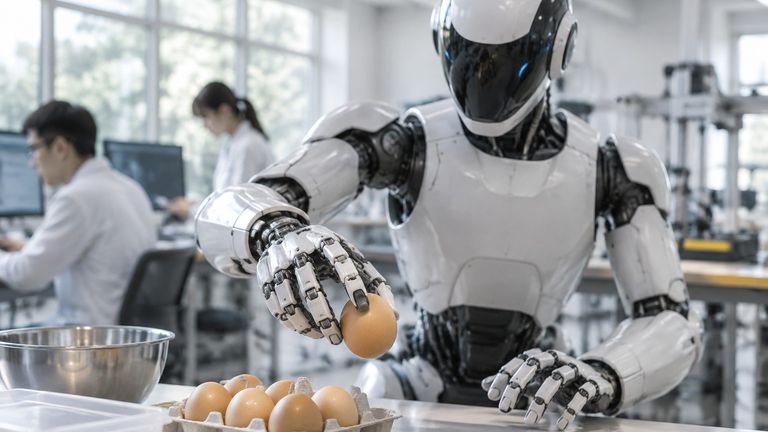
Genesis's first general-purpose robot, Eno, was unveiled in June 2026. It has a wheeled base, two robotic arms and a pair of dexterous hands, but no human-like head or legs.
The company said it chose not to use a humanoid form factor because it prioritized reliability and mass production.
Zhou put it more bluntly: “Why does a robot need a head? It doesn't have a brain. Isn't it just somewhere to put a camera?”
The pairing of its two co-founders offers some clues. Zhou, born in 1994, earned his bachelor's degree from Nanyang Technological University in Singapore and began a PhD in robotics at Carnegie Mellon University in 2017. Fellow co-founder Théophile Gervet also earned his PhD from Carnegie Mellon. He was previously a founding member of embodied AI unicorn Skild AI and a research scientist at Mistral AI.
The money has also arrived quickly. Genesis raised a $105 million seed round in July 2025, followed less than 18 months later by the $500 million round in November 2026 at a $3.5 billion post-money valuation. Its GENE-26.5 robotics foundation model, released in May 2026, aims to bring general-purpose robotic manipulation close to human levels.
NVIDIA Backed Both Companies
Genesis's round was co-led by Premji Invest, Khosla Ventures and Eclipse. Other participants included Durable Capital Partners, French public investment bank Bpifrance, HSG, NVIDIA's NVentures, AMD Ventures, Zoom Ventures, Samsung Next and Ericsson Ventures.
Agile Robots' round was led by SoftBank Group, with NVIDIA, Hitachi Group and T.Capital also participating. NVIDIA invested directly.
One company is building non-humanoid robots, the other humanoids. One is based in France, the other in Germany. One is at Series A, the other at Series F. NVIDIA has put money into both.
The roster of individual investors is also notable: former Google CEO Eric Schmidt, Zoom founder Eric Yuan, former Yahoo CEO Jerry Yang and former Tesla CFO Zach Kirkhorn. Most of the people on this list have already profited from the previous wave of AI.
Turning a Physical Problem Into a Computing Problem
Genesis's methodology was laid out more clearly by another co-founder, Wang Zunxuan, at the 2026 World Artificial Intelligence Conference in July 2026.
Wang said robotics is fundamentally a systems engineering problem. Large models can be trained directly on internet data, but robots cannot. Hardware, data collection, training environments, evaluation systems and deployment all have to be addressed at once.
Genesis's answer is high-fidelity simulation, with simulated environments serving as the core platform for model evaluation and reinforcement-learning post-training. The logic is straightforward: if simulation aligns closely enough with reality, robot training can scale like coding agents through massively parallel computing, turning a physical problem into a computing problem.
The ambition lies in scalability. Real-world data must be generated by running individual robots in physical environments, which is slow and expensive. Simulation data can be generated in parallel and, in theory, without limit. Large models scaled by trading computing power for data; Genesis wants to apply the same playbook to robotics.
A Gap Still Separates Simulation From Reality
Wang has acknowledged the problem himself: closing the gap between simulation and reality remains a long-term challenge for the industry. Correlation between the two has improved in recent years, but uncertainties in the physical world, including object friction, changing lighting and contact dynamics, remain difficult to simulate fully.
This is the shared weakness of every company pursuing a simulation-first approach. No matter how well a model performs in simulation, how much performance it loses when transferred to a physical robot depends on how narrow that gap is. Genesis says Eno is not bipedal because of reliability and mass-production considerations. In the context of a simulation-led strategy, those two priorities ultimately point to the same issue.
Agile Robots Is Taking a Different Path
Agile Robots was spun out of the German Aerospace Center in 2018. Founder and CEO Chen Zhaopeng graduated from Harbin Institute of Technology before joining the DLR Institute of Robotics and Mechatronics. He was part of the team that developed the DLR/HIT Hand II, a five-fingered dexterous hand jointly created by HIT and DLR.
Its product lineup includes humanoid robots, mobile robots, robotic arms and dexterous hands, along with supporting software and AI models. Since its founding, the company has deployed 20,000 industrial robotics solutions for customers in sectors including automotive manufacturing, consumer electronics and logistics.
The latest funding will go toward expanding production capacity and entering new markets. Agile Robots plans to strengthen its presence in the United States while continuing to add capacity in Germany and elsewhere. In early 2026, it opened a new production facility in Fürstenfeldbruck, near Munich, with annual capacity of up to 10,000 legged and wheeled humanoid robots.
Both companies raised $500 million. Genesis will use the money to accelerate R&D and deployment, recruit talent and focus primarily on manufacturing and logistics. Agile Robots will use its funding to build production lines. One is working to train the model; the other is working to build the machines.
Neither path has reached the finish line. To justify its $3.5 billion valuation, Genesis must prove that models trained in simulation can perform reliably on physical robots. To fill capacity for 10,000 units, Agile Robots must prove that humanoid robots can actually replace human workers in factories. The same week and the same $500 million bought two very different bets.




Comments
00No comments yet. Be the first to weigh in.