

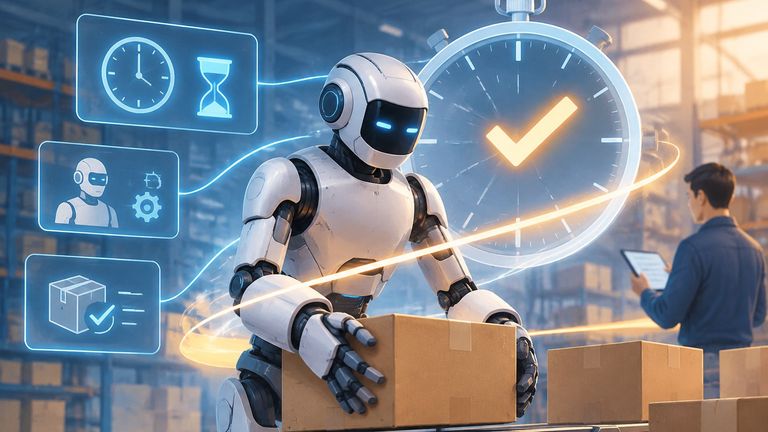
The APEC CEO Summit was held in Shenzhen from November 17 to 18. Xiaomi founder, chairman and CEO Lei Jun said at the event that the company’s embodied-intelligence robots had begun real-world operational testing in factories. They can work continuously for eight hours and autonomously recharge twice during that period.
His assessment: “I think that performance is already outstanding.”
Amid a series of broad observations about artificial intelligence, this was the most concrete statement in the entire speech: eight hours and two recharges. Everything else was about direction.
Eight Hours, Two Recharges
Eight hours is exactly the length of a standard shift. Workers change shifts, and so do robots. The difference is that no one needs to take over from the robot.
But the second half of the statement is what really matters: during those eight hours, the robot recharged itself twice.
If its battery could last the full eight hours, there would be no reason to mention “two recharges.” The implication is clear: a single charge cannot cover an entire shift, so the robot must replenish its battery along the way, and it does so on its own.
What do two recharges mean in practice? Dividing eight hours evenly suggests one recharge roughly every two hours and 40 minutes. Lei did not disclose the duration of each charging session or the battery capacity, so it is impossible to determine how much time the robot spent working and how much it spent charging. That will require further data.
Charging Is Harder Than Battery Life
When robots enter factories, battery life is often the first concern. But runtime can be extended simply by adding batteries. Building enough capacity for eight hours is not difficult, although it adds weight and cost.
The harder problems lie elsewhere. How does the robot know when its battery is low? Once it knows, how does it reach the charging station? How does it align itself with the connector? And after charging, how does it return to the task it was performing?
If any one of those four steps fails, the claim of eight-hour operation falls apart. The figure is therefore less a test of the battery than of whether the robot can resume and complete an interrupted task without human assistance.
That is also the dividing line between a factory deployment and a demonstration. A robot at a product launch can be helped on and off the stage; a robot on a production line cannot. The ability to recharge twice while maintaining continuous operation suggests that the charging process no longer requires human intervention.
Lei said only that the robot “autonomously recharged twice.” He did not explain how it located the charging station, what positioning technology it used or whether a person had to confirm anything during charging. Those details will determine whether the system is truly autonomous or only semi-autonomous. For now, that remains unclear.
Factories Must Learn to Detect Problems on Their Own
Lei described the process in two stages.
The first has been underway for several years: using AI to optimize every stage of factory production. At this stage, AI is a tool, while people still make the decisions, determining which processes are too slow and where adjustments are needed.
The second, which Xiaomi is now exploring, is to upgrade the factory into an “industrial AI agent capable of autonomous production, autonomous problem detection and autonomous iteration.”
These three forms of “autonomy” build on one another. Autonomous production means executing tasks correctly. Autonomous problem detection means recognizing what has gone wrong. Autonomous iteration means making corrections after identifying a problem. Conventional automation has long been capable of the first layer. The second requires perception and judgment, while the third involves accumulating experience.
Factory testing of robots sits somewhere between the first and second layers. A robot can work and recognize when its battery is running low enough to require charging. But whether deciding to recharge qualifies as “detecting a problem” depends on whether the situation was predefined.
Lei Jun Says Few AI Companies Are Making Money
The least promotional line in the entire speech was Lei’s assessment of the industry’s current state.
His exact words were that over the past four years, rapid advances in AI foundation models had brought major changes to people’s work and lives. But given the “extremely, extremely large investment in AI,” the number of viable use cases remained very limited, while relatively few companies had achieved a closed commercial loop and become profitable.
The significance of that statement lies in who made it. Xiaomi is investing in this field; it is not a bystander. When an investor publicly says that “few are making money,” the comment is more noteworthy than any criticism from outside the industry.
It also sets a boundary around the eight-hour figure: being able to work and being able to make money are two different things. Completing a full shift demonstrates technical feasibility. Whether the value created during that shift can cover depreciation, maintenance and electricity costs is a separate calculation, and no one provided it this time.
Four Years Without a Breakthrough Product
Lei also offered a broader timeframe.
Using smartphones and cars as examples, he said that while no revolutionary benchmark product had emerged over the past four years, breakthroughs could come in the next few years as AI technology becomes deeply integrated with end-user devices. “I believe that great products will undoubtedly emerge in these fields over the next few years.”
That statement sets expectations on a scale of “years,” not next year and not this product generation.
The same timeframe applies to embodied intelligence. An eight-hour operational test is one validation milestone, but the technology remains some distance from mass production and a finalized product. Lei disclosed no delivery volumes, customer list or mass-production timetable. Those omissions are themselves informative.
Lei concluded with a broader point: AI is not only about the emergence of new technologies. More importantly, every industry should use AI-based models, thinking and technology to reshape itself. The same applies to Xiaomi: factories must first be transformed by AI before robots have a place to work.


Comments
00No comments yet. Be the first to weigh in.